Arthur Sinclair, Junior
World War ZArthur Sinclair, Junior, is the wartime director of the U.S. government’s Department of Strategic Resources, or DeStRes, the institution charged with rebuilding a shattered American society while the living dead still assault its defensive lines. His decisive significance lies in the conversion he oversees: a postindustrial population and a landscape of rubble, refugees, hunger, disease, and broken transport must be remade into a self-supporting society capable of sustained war production. Sinclair begins as an old-world patrician and former Wall Street figure, but the crisis forces him to recover the practical collectivist lessons of his New Dealer father and apply them to a country that can no longer afford its prewar divisions between specialized white-collar work and essential manual skill.
Identity and Background
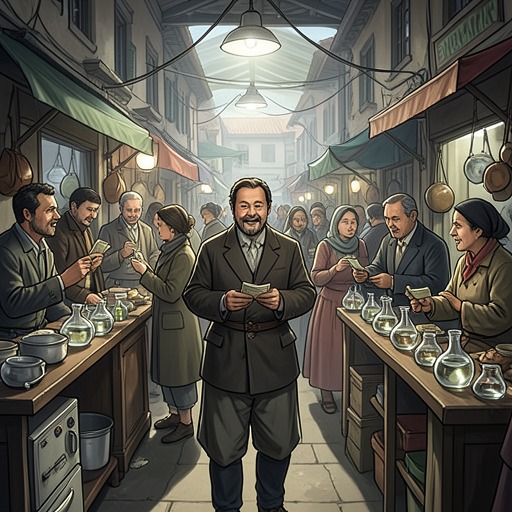
Arthur Sinclair, Junior, is presented as tall and lean, with close-cropped white hair and an affected Harvard accent. He speaks into the ether, seldom making eye contact and rarely pausing for questions, a manner that places him physically and rhetorically above the interview. During the war, he directs DeStRes, whose name sounds uncomfortably like “distress,” an accidental description of the world it inherits. The Rocky Mountains may offer a theoretical defensive line, but the supposed safe zone is filled with millions of refugees, homelessness, starvation, disease, ruined industry, vanished transportation and trade, and the constant presence of the living dead both outside and within its boundaries.
Sinclair’s authority is therefore administrative rather than merely military. His task is to get people clothed, fed, housed, and back to work before the safe zone becomes only a delay before collapse. He admits that the position required extensive on-the-job training. In the first months he absorbs briefings and inspection tours while sleeping with books beneath his pillow, studying figures ranging from Henry J. Kaiser to Vo Nguyen Giap. The breadth of this self-education reveals a man trying to turn scattered historical experience into a usable reconstruction doctrine.
His father had been a staunch New Dealer who worked closely with FDR as comptroller of New York State. Sinclair had rejected those lessons and fled toward Wall Street, but the war makes their value unavoidable. He recalls that the New Dealers were exceptionally good at finding and harvesting the right tools and talent, and that principle becomes the intellectual foundation of his reconstruction work. The son’s transformation is consequently not a clean ideological conversion so much as an enforced return to knowledge he had once dismissed.
Reconstruction and the National Reeducation Act
Sinclair defines “talent” as the potential workforce, its level of skilled labor, and the ways that labor can be used effectively. The problem is that prewar America had become a postindustrial, service-based economy so complex and specialized that people were trained to function only inside narrow compartments. The first employment census is crowded with executives, representatives, analysts, and consultants—occupations suited to the old economy but inadequate to a crisis requiring carpenters, masons, machinists, and gunsmiths.
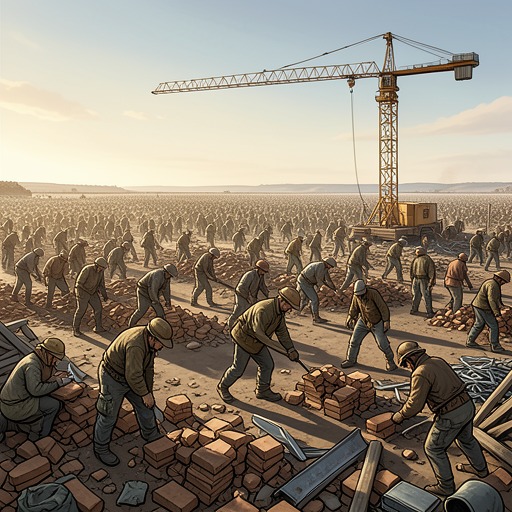
The figures make the mismatch concrete: more than 65 percent of the civilian workforce is classified F-6, meaning that it possesses no valued vocation for the emergency. Sinclair responds with a massive retraining effort. Refugee camps become the mechanism for reorganizing the population. Hundreds of camps, ranging from parking-lot settlements to communities spreading for miles across mountains and coasts, consume government assistance while resources diminish. Sinclair’s first priority is to empty them by assigning physically capable F-6 civilians to unskilled labor such as clearing rubble, harvesting crops, and digging graves.
Those with war-appropriate skills are classified A-1 and placed in the Community Self-Sufficiency Program, or CSSP. Instructors teach sedentary, overeducated, desk-bound civilians how to survive without the disposable conveniences of the consumer economy. Many instructors are first-generation immigrants who already know how to maintain gardens, repair houses, and keep appliances functioning long after their intended service life. Sinclair recognizes the cultural conflict involved: people whose labor sustained the comfortable prewar lifestyle must now teach others to abandon that lifestyle.
The CSSP produces an immediate measurable result. Within three months, requests for government aid fall sharply, allowing society to move from a zero-sum survival economy into full-scale war production. Sinclair identifies the National Reeducation Act as the organic outgrowth of the CSSP and describes it as the largest jobs-training program since the Second World War and the most radical in American history. Its radicalism lies not only in vocational instruction but in forcing a segregated workforce to exchange status, specialization, and inherited comfort for practical interdependence.
Resources, Logistics, and Strategic Judgment
Sinclair’s economic thinking is grounded in material limits. A bottle of peacetime root beer depends on an elaborate chain of ingredients, including pimento berry oil from Jamaica and balsam oil from Peru; even an apparently ordinary consumer product therefore presupposes global extraction, manufacturing, and transport. During the war, the living dead control most of the world’s landmass, while American production depends on what can be harvested in the western states. Overseas raw materials are unavailable, the merchant fleet is crowded with refugees, fuel shortages have immobilized much of the navy, and the country must function as if it were the resource-starved Axis rather than one of the industrial Allies.
Sinclair explains victory in the Second World War through three connected advantages: the ability to manufacture more materiel, access to the natural resources needed for that manufacture, and the logistical capacity to move resources to factories and finished goods to the front. In the new war, America cannot rely on an entire planet. California’s agricultural base may prevent starvation, but only after it is restructured, and powerful citrus growers and ranchers resist the conversion of their land. Sinclair’s reconstruction is therefore a struggle over fields, labor, transport, and the definition of legitimate national need, not simply a program of bureaucratic efficiency.
His most consequential military partnership is with General Travis D’Ambrosia, who, after becoming chairman of the Joint Chiefs, develops the resource-to-kill ratio and a comprehensive strategy based on it. Sinclair trusts his judgment about the Battle Dress Uniform and the Standard Infantry Rifle, accepting that weapons must be evaluated by what they cost against how many living dead they can destroy. The principle spreads beyond official policy. Soldiers begin comparing weapons by their relative killing power and resource demands, and rank-and-file improvisation produces tools more cost-effective than anything the bureaucracy had imagined.
The Standard Infantry Rifle embodies this philosophy. Its wood furniture makes it resemble a World War II weapon, while its uncertain ancestry matters less than its battlefield reliability: it fires semi-automatically, remains accurate, and does not jam even after mud, sand, or saltwater exposure. A conversion kit allows the same weapon to function as a long-range sniper rifle, midrange rifle, or close-combat carbine, and a built-in spike supplements it when the Lobotomizer is unavailable. Its ammunition, the NATO 5.56 Cherry PIE round, shatters inside a zombie’s skull and burns the brain without spreading infected gray matter, eliminating the need for wasteful mass burnings and allowing whole bodies to be buried during BS4 duty.
Failure, Experiment, and Adaptation
Sinclair is not portrayed as infallible. He admits to being too conservative about the air force’s D-Corps because he distrusted the dangers of hydrogen-powered dirigibles in an environment with negligible helium. He also had to be persuaded by the president to reopen the experimental cold-fusion project at Livermore. The president’s argument was that planning for a future reassures people that a future exists, exposing a limit in Sinclair’s strict short-term resource calculus: morale and long-range expectation can themselves be strategic resources.
His clearest mistake is Project Yellow Jacket. Silicon Valley scientists promise a wonder weapon capable, in theory, of winning the war within forty-eight hours of deployment. The project would scatter millions of micro-missiles, each roughly the size of a .22 rimfire bullet, from transport aircraft and guide them by satellite into the brains of every zombie in North America. Sinclair is seduced by the vision, then regrets the resources poured into it and the production that might have been achieved instead. His remorse is not abstract; it is an acknowledgment of opportunity cost, the central discipline he otherwise tries to impose on wartime decision-making.
He also becomes involved in the repurposing of advanced technologies. The Zeus laser weapon, originally designed to clear land mines and unexploded bombs from a specialized Humvee, is adapted against the living dead. Its pulse beam can burn through a bomb casing or heat the explosive until detonation; against zombies, higher settings punch through the forehead, while lower settings boil the brain until it erupts through the ears, nose, and eyes. Sinclair’s immersion in the project shows his attraction to technical possibility, even as the wider narrative repeatedly tests whether spectacular technology can survive industrial and logistical reality.
His administrative vision extends to the Continental Airlift, the statistically largest undertaking in air force history. The operation must maintain contact with scattered defended settlements, process their demands, coordinate with DeStRes, and procure and prioritize material for each drop. Sinclair favors self-sustaining drops—tools, spare parts, and equipment for making more spare parts—over dependency drops of food and medicine. Yet winter forces compromise: fish, wheat, salt, dried vegetables, and baby formula still have to be delivered, because teaching communities to support themselves cannot substitute for keeping them alive during the transition.
The airlift also inserts specialists into isolated settlements. Doctors and engineers provide knowledge that cannot be obtained from manuals, while Special Forces instructors teach Blue Zone populations both improved defense and preparation for eventual offensive action. Many instructors parachute into places without airstrips and with no prospect of retrieval; some Blue Zones are eventually overrun. Sinclair’s system thus depends on a combination of infrastructure, sacrifice, and improvised continuity rather than on centralized control alone.
Narrative Role and Significance
Sinclair’s account makes war legible as a problem of production, labor, transportation, and institutional learning. The threat consists of two hundred million zombies, a number that overwhelms ordinary visualization, while conventional military history offers little guidance against an enemy that does not need to be bred, fed, or led. Sinclair’s reconstruction effort answers that asymmetry by rebuilding the living around precisely those requirements: people must be trained, supplied, organized, and given tools that work under prolonged pressure.
His characterization is shaped by contradiction. He is an aristocratic, self-consciously cultivated bureaucrat who learns from mechanics, immigrants, soldiers, and the practical habits of people he once might have regarded as socially distant. He speaks with confidence but records failure; he prizes efficiency but acknowledges morale; he distrusts waste yet is briefly captivated by Project Yellow Jacket; he inherits collectivist methods only after spending years rejecting them. These tensions make him more than a spokesman for DeStRes. He becomes the human face of a society forced to discover that its survival depends on capabilities it had allowed specialization and consumer comfort to bury.
The recurring contrast between impressive machines and basic material needs defines Sinclair’s importance. A laser can boil a zombie’s brain, a satellite can guide a micro-missile, and an orbital vehicle can be modified for manual flight, but none of these systems matters without fuel, ammunition, trained labor, replacement parts, and an organization capable of sustaining them. Sinclair’s lasting contribution is the insistence that victory comes from linking those elements into a chain. He helps turn a defensive refuge into a functioning war machine by teaching the living not merely to consume rescue, but to manufacture, repair, transport, adapt, and continue.